Why We Break Our Own Promises To Ourselves

Ever wonder why we promise ourselves things like “tomorrow I’ll start exercising and eating only healthy foods”, but don’t follow through?
People make those heartfelt “tomorrow I’ll change” promises — and genuinely mean them in the moment — because the brain is wired for intention, not always for follow-through.
Here’s why we so often fail to deliver on promises to ourselves:

  1. The Planning Fallacy
    When we’re calm and motivated (often at night or after a “bad day”), we underestimate how hard it will be tomorrow. We imagine future-us having unlimited willpower, no stress, no temptations. Reality hits: tired, busy, triggered — and the plan crumbles.
  2. Decision Fatigue & Willpower as a Limited Resource
    Willpower isn’t infinite. It gets depleted by stress, decisions, hunger, even low blood sugar. By afternoon/evening, the brain defaults to the easiest, most familiar choice (take-out over healthy home cooking, scrolling over exercise).
  3. Immediate vs Delayed Rewards
    Eating chips or take-out = instant dopamine hit.
    Saying no = delayed reward (better health, clothes fitting).
    The brain is wired to prioritize now over later — evolution favored survival, not long-term goals.
  4. Identity Gap
    We say “tomorrow I’ll be the healthy/disciplined person.”
    But deep down, current identity is “I’m someone who loves convenience” or “I’m not great at sticking to routines.”
    Until the identity shifts (“I’m someone who feels amazing when I exercise and plan ahead so I actually eat real food”), the old habits win.
  5. No Real Plan or Accountability
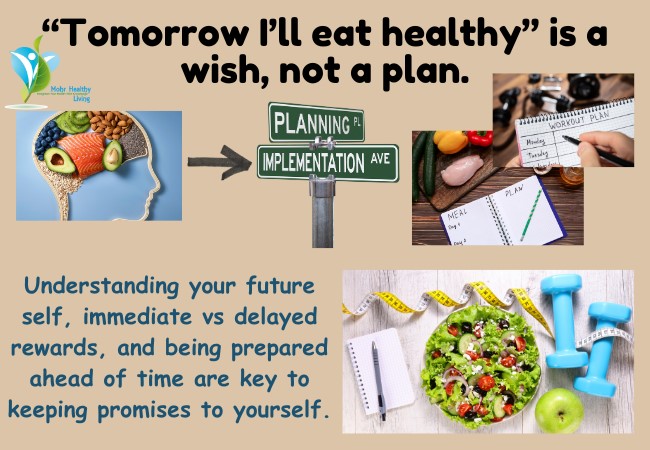
    “Tomorrow I’ll eat healthy” is a wish, not a plan.
    No prep (healthy food in house? Meal plans?), no environment change (chips gone?), no accountability (tell someone?) — so when temptation hits, the vague intention loses.
  6. Emotional Triggers We Ignore
    Often the craving isn’t hunger — it’s boredom, stress, reward-seeking, or habit.
    We promise “no chips” without addressing why we reach for them.

We do mean it when we say it — because in that moment, we’re connected to our higher consciousness.  But without systems (prep, environment, identity shift), biology and habit override intention. 

The fix isn’t more willpower.
It’s smaller promises, better planning, and compassion when we slip (beating ourselves up guarantees another “tomorrow I’ll start again”).
You’re not weak.
You’re human.

Leave a Reply

Your email address will not be published. Required fields are marked *

This site uses Akismet to reduce spam. Learn how your comment data is processed.