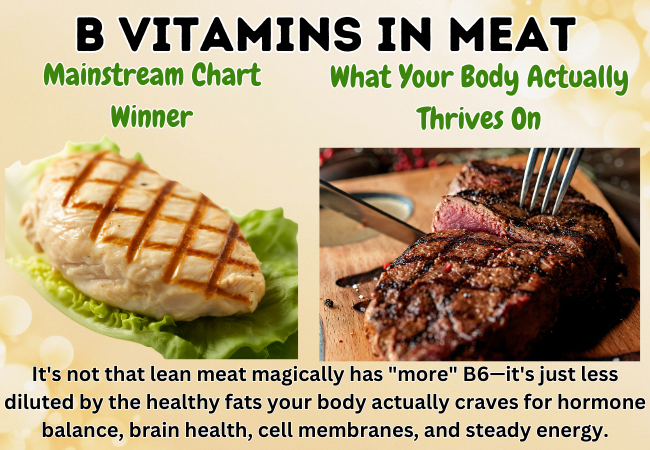
Mainstream nutrient charts love to push “lean” cuts of meat as having “more” B vitamins per ounce. But here’s the truth:
Fat itself contains basically zero B vitamins. So when you compare equal weights, leaner cuts look like they win because the fat isn’t diluting the nutrient-rich muscle meat.
Fattier cuts (thighs, shoulder, marbled loin, ribs) deliver comparable (sometimes even higher) total amounts of B vitamins PLUS the healthy saturated and monounsaturated fats your body actually craves for hormone production, cell membrane health, brain function, steady energy, and satisfaction.
Don’t fall for the low-fat myth—choose what feels right for your body. More fat = more satisfaction, better hormones, and real nourishment. Listen to your body, not outdated low-fat food lists. 💪
Quick Rundown: B Vitamins in Meats
All the B vitamins you’re getting from meats are mostly in the lean muscle tissue (water-soluble, not stored in fat), so the “density per ounce” trick applies across the board—leaner cuts look higher per gram because fat has none. But fattier cuts give you:
- Similar total amounts per realistic serving (you eat more volume of the meat itself when it’s juicy and flavorful).
- Better overall nutrient synergy with the fats: fats help utilize the Bs (especially for energy metabolism and nerve health), plus they provide satiety so you don’t overeat carbs to compensate.
- Extra bonuses from marbling/organ-adjacent cuts (like shoulder or blade): more zinc, iron, and selenium that work hand-in-hand with the Bs.
Key B vitamins in meats (pork, beef, chicken, turkey, etc.):
- B1 (Thiamine) – present, but not super high in most cuts (highest in pork). Energy from carbs/proteins, nerve function.
- B2 (Riboflavin) – Solid amounts in all meats, especially liver, dark poultry, and fatty fish. Energy production, antioxidant protection.
- B3 (Niacin) – Very high in all muscle meats (chicken breast, turkey, beef, pork, tuna, salmon) Cholesterol balance, skin/nerve health.
- B5 (Pantothenic Acid) – Good amounts in liver, chicken, beef, pork. Hormone/adrenal support, energy.
- B6 (Pyridoxine/P5P) – High across the board. Neurotransmitters, hormone balance.
- B7 (Biotin) – Decent in liver, eggs, pork, beef. Hair/skin/nails, fat metabolism.
- B9 (Folate) – Higher in liver and organ meats, moderate in muscle meats. Cell repair, mood support.
- B12 (Cobalamin) – Extremely high in all animal foods, especially liver, red meat, shellfish, fatty fish. Nerve health, red blood cells (highest in animal foods, especially liver/organs).
Fattier cuts don’t “dilute” these much in practice because people eat satisfying portions, not tiny lean ones. Plus, the fats themselves are carriers for the Bs’ effects—think smoother energy, calmer nerves, better mood without the carb rollercoaster.
Pasture-Raised Animal Sources
Choose pasture-raised/grass-fed animal sources for optimal nutrient delivery without the modern feedlot compromises—like grain-heavy diets that spike inflammatory omega-6s, lower beneficial fats, and reduce phytochemicals from diverse plants. Instead, animals grazing on natural grasses deliver meat and fats richer in anti-inflammatory omega-3 fatty acids (often 3–5x more), conjugated linoleic acid (CLA, up to 2–3x higher for better fat metabolism and cell protection), vitamin E (antioxidant power 3x+), beta-carotene, and other phytonutrients/polyphenols that support mitochondrial energy, reduce oxidative stress, and promote true healing. Feedlot compromises often mean higher total fat but skewed toward pro-inflammatory profiles, fewer antioxidants, and less overall nutrient density—missing the full spectrum your body craves to self-regulate and thrive.
Animal Sources vs. Plant Sources
Animal foods generally deliver forms that are more bioavailable and closer to the “finished,” active versions your body can use right away (or with minimal conversion steps)—especially B3, B5, B6, B7, B9 and B12. That leaves B1 and B2 which are similarly bioavailable in both plant and animal sources.
Plant sources often provide precursor forms that require more processing in the body, can be bound up (e.g., by fiber or anti-nutrients), or convert less efficiently—especially under stress, gut issues, or genetic quirks that slow those pathways.
In short: Animal sources deliver B vitamins in the most bioavailable forms your body can use right away—far more effectively than plants. Fattier cuts from pasture-raised, grass fed animals bring the added gift of healthy saturated and monounsaturated fats that our bodies crave. So go ahead—grab that juicy ribeye or juicy chicken thigh, savor every bite, and let your body thank you.

2 Responses
Admin / Terry Chamberlin / Angie Mohr: Thank you for this information! I am curious as to what your opinion is on Dr. Gundry’s research? (especially re: lectins). I have recently started Dr. D’Adamo’s Blood Type Diet (I’m a B). Your insight greatly appreciated.
Hi Arlene – Terry isn’t involved with this website, it’s my own.
I don’t go along with Dr. Gundry much at all. If you have a healthy gut you can handle some lectins and you can also soak beans and even sprout before eating which helps with lectins.
No to blood type diet, no science backs it up. If I went by that I’d not be able to eat avocados, and I eat them daily.
From what the research shows (like a 2013 systematic review and a 2014 study testing it on real people), there’s zero solid evidence that matching your diet to blood type delivers unique benefits. Sure, some folks see improvements in cholesterol, blood pressure, or energy—but those gains happen across all blood types when following the plans. Why? It’s the healthy eating habits doing the work: More whole foods, veggies, proteins, and fats, less processed junk. Not magic blood-type matching.
The “personality reveals” tied to blood types (like Type O being confident leaders or Type A perfectionists) are fun for pop culture (hello, Japanese matchmaking apps!), but they’re basically zodiac-level entertainment—no hard science linking ABO groups to traits or deep insights.
Bottom line: Eat what fuels you—whole foods, balanced macros (I’m all about keto-friendly fats and proteins over carb overloads). If a diet works, it’s likely because you ditched the crap, not ancient blood secrets.